
By Ahmad Al Shami | 20 October 2026
What is changing in COBIT 7—and what does it mean for AI transformation? The announced direction combines digital-first delivery, customizable assessment and supporting guidance. The business opportunity is to turn governance knowledge into clearer priorities, accountable decisions and evidence of improvement.
COBIT 7 is approaching. ISACA’s Sydney chapter identifies 27 October 2026 as the debut date for a digital-first framework and a new Foundation Certificate. ISACA’s official A First Look at COBIT 7 webinar, scheduled for 3 November, describes an October publication with a new digital presentation, assessment tools and supporting guidance. [1][2]
Pre-launch perspective: this article separates those announcements from my recommendations. It is not a review of the complete COBIT 7 framework, a detailed comparison with COBIT 2019, or an official migration guide.
Watch: What is new in COBIT 7?
A 3½-minute illustrated explanation of the confirmed announcements, their practical implications and the details still awaiting verification. Independent pre-launch commentary, 20 October 2026. AI-generated American Michael narration.
What is new in COBIT 7: the confirmed direction
The most concrete announced change is how practitioners will access and assess governance. ISACA describes more digital delivery and a flexible assessment module intended to expose governance and management gaps. Its November preview also promises supporting guidance. The table distinguishes those announcements from my interpretation of their practical value. [2][3]
| Announced change | What the source establishes | My interpretation for practitioners |
|---|---|---|
| Digital-first delivery | More framework content delivered digitally; a new digital presentation. [1][2][3] | A chance to use the framework more directly in governance work. Test navigation, access and usability when released. |
| Customizable assessment module | A flexible module to identify gaps in governance and management practices and prioritize improvement in the enterprise context. [3] | Connect assessment findings to evidence, accountable owners and a measurable improvement backlog. |
| Supporting guidance and digital tools | ISACA’s preview will cover supporting guidance, tools and their use. [2] | Evaluate the actual guidance against your operating needs before changing methods or buying additional tooling. |
| New Foundation learning pathway | A new Foundation Certificate, instructor-led training and an online review course accompany the announced debut. [1] | Align team training with the version they will actually study and use. |
What does the update address for leaders?
The announced assessment direction addresses a practical problem: finding where governance is weak and where improvement matters most. The digital delivery direction addresses how the framework is presented and used. Together, these developments create an opportunity to connect governance knowledge with an evidence-based improvement cycle. That final connection is my interpretation, not a promise of automated controls or real-time assurance.
For AI transformation, I would apply this opportunity across five operating questions:
- Strategy and value: which business outcome should the investment improve, and who owns the benefit?
- Architecture and dependencies: which capabilities, information, services and suppliers determine whether the proposed workflow can work?
- Authority and risk: which decisions remain human, what may an agent do, and where must it stop?
- Execution and resilience: how are permissions, approval, exception handling and recovery enforced?
- Performance and assurance: what evidence demonstrates accepted outcomes, control effectiveness and justified cost?
These are application questions for leaders, not newly verified COBIT 7 domains. ISACA’s existing AI governance white paper already discusses strategic alignment, accountability, ethical concerns and life-cycle governance. AI governance therefore does not begin with COBIT 7, and the earlier paper should not be presented as proof of a specific new version requirement. [4]
Which detailed changes still need verification?
As of 20 October, the primary announcements reviewed here do not provide a complete revised core model, objective-by-objective comparison, design-factor specification or assessment scoring method. I cannot responsibly turn those gaps into a definitive migration table. The 3 November ISACA preview explicitly includes differences from COBIT 2019 among its learning objectives. [2]
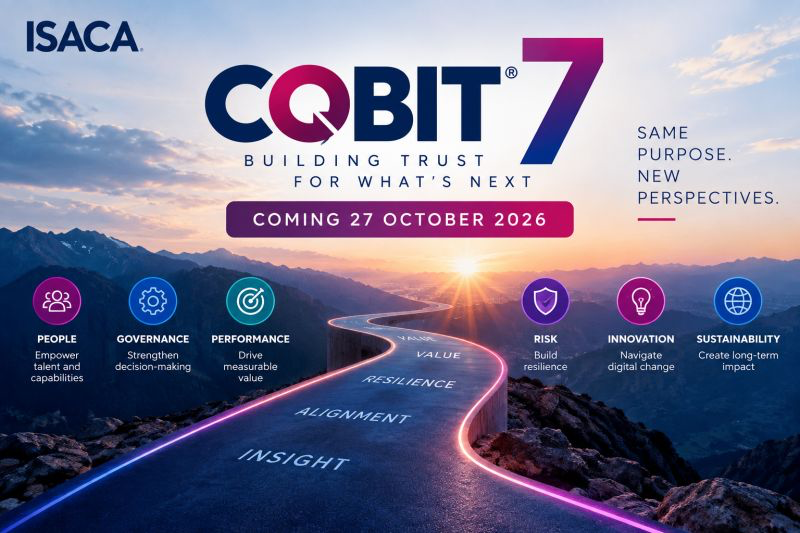
The promotional artwork highlights people, governance, performance, risk, innovation and sustainability. Those labels should not be treated as proof that six formal domains replace the current model, or that new objectives have particular numbers. Release-specific mappings, detailed AI requirements and claims of compatibility require the authoritative materials.
Transition dates: learning programmes and exams
- 26 October 2026: last purchase date announced for COBIT 2019 Foundation and Design & Implementation programmes.
- 27 October 2026: announced COBIT 7 and Foundation Certificate debut.
- 26 April 2027: last examination date announced for the retiring 2019 programmes, with no extension.
People who already earned those certificates retain them. A new COBIT 7 Design & Implementation Certificate is planned for 2027; an exam sunset is not withdrawal of earned certificates. Verify your own booking with ISACA. [1]
Why this matters for AI transformation
My view is that AI transformation needs governance that can answer concrete operating questions. Which business outcome justifies the investment? Who is accountable for an agent’s permitted actions? Which information may it access? Who resolves exceptions? What evidence supports a decision to expand its scope?
These questions exist before the new release. The launch offers a useful moment to test whether the organization’s governance arrangements can answer them consistently.
A business may introduce AI into customer service, procurement or decision support while retaining fragmented approval rights and incomplete information ownership. A capable model cannot resolve those organizational ambiguities by itself.
Five preparations leaders can make now
| Preparation | Practical evidence to collect |
|---|---|
| Connect investments to value | Business objectives, benefit owners, agreed measures and the dependencies behind each claimed benefit. |
| Clarify decision authority | Named accountable people, delegated limits, approval routes and responsibility for exceptions. |
| Understand the operating environment | Critical capabilities, information owners, suppliers, applications and services supporting the selected workflow. |
| Test controls in execution | Evidence of access enforcement, approval checks, logging, recovery and independent review where required. |
| Baseline and prioritize improvement | Current findings, evidence gaps and a funded, owned improvement backlog. |
These are my preparation recommendations, not a claimed list of new COBIT 7 requirements. They create a stronger basis for evaluating the release when its full guidance is available.
An agentic procurement example
Consider a proposed purchasing assistant that gathers supplier information and recommends an order. The business goal might be more reliable procurement with less administrative effort. The governance design must also make authority explicit.
The agent can prepare a recommendation within its permitted information scope. An authorized person evaluates exceptions and approves where policy requires. The purchasing system verifies authority, approved scope and transaction state before issuing an order. If the result is uncertain, a person reconciles it before any retry that could create a duplicate commitment.
This is an illustrative design, not a client implementation or a statement that COBIT 7 mandates those particular mechanisms. It shows how governance can be translated into observable behavior rather than remaining a policy statement.
Business architecture makes the governance context visible
I would connect the governance discussion to a traceable business view: objective, stakeholder value, capability, workflow, accountable role, information, application service and operating evidence.
Business architecture helps explain what the organization needs to achieve and where a change has impact. Enterprise architecture connects that intent to systems, integrations and technology dependencies. Governance establishes how direction, authority, oversight and accountability operate across that arrangement.
The disciplines should support one another. A capability map does not prove that permissions are enforced. An audit log does not prove that an investment creates value. Leaders need both a coherent design and evidence of what actually happens.
A controlled approach to the release
Before launch, preserve the current assessment baseline and record which version supports it. Identify the business decisions that a framework update needs to improve. Avoid relabelling existing tools or scores prematurely.
After publication, review the authoritative materials, identify relevant changes and validate any mappings with responsible practitioners. Pilot the revised approach in a bounded area before changing enterprise-wide reporting. Keep the old and new assessment bases distinguishable so an apparent score change is not mistaken for a real improvement.
Communicate the implications to business owners, technology leaders, risk teams and assurance functions. The result should be an agreed improvement plan with owners and review evidence—not merely a new framework diagram.
Use existing work without overstating readiness
My COBIT Design Toolkit can support discussion of the existing governance-design approach. This article does not certify it as COBIT 7-compatible or announce an upgrade to it. Version-specific changes require a separate review.
For an end-to-end service example, explore Domain Reimagination. To discuss your governance priorities, book an AI transformation and governance consultation.
The immediate opportunity is to make governance more usable: connect strategic intent to responsible decisions, controlled execution and measured outcomes. COBIT 7 should be evaluated against that business need when the full release becomes available.
Sources and perspective
[1] ISACA Sydney Chapter, Latest News and Updates, COBIT 7 debut announcement. Accessed 20 October 2026.
[2] ISACA, A First Look at COBIT 7, webinar listing for 3 November 2026. Accessed 20 October 2026.
[3] ISACA, Celebrating Three Decades of COBIT, 20 April 2026. Accessed 20 October 2026.
[4] ISACA, Leveraging COBIT for Effective AI System Governance, 31 January 2025. Existing guidance; not a COBIT 7 change specification.
Updated 20 October 2026 to expand the confirmed changes and their practical implications.
Independent pre-launch commentary. COBIT® and ISACA® are trademarks of ISACA. No affiliation, endorsement, COBIT 7 certification or verified migration outcome is implied.