
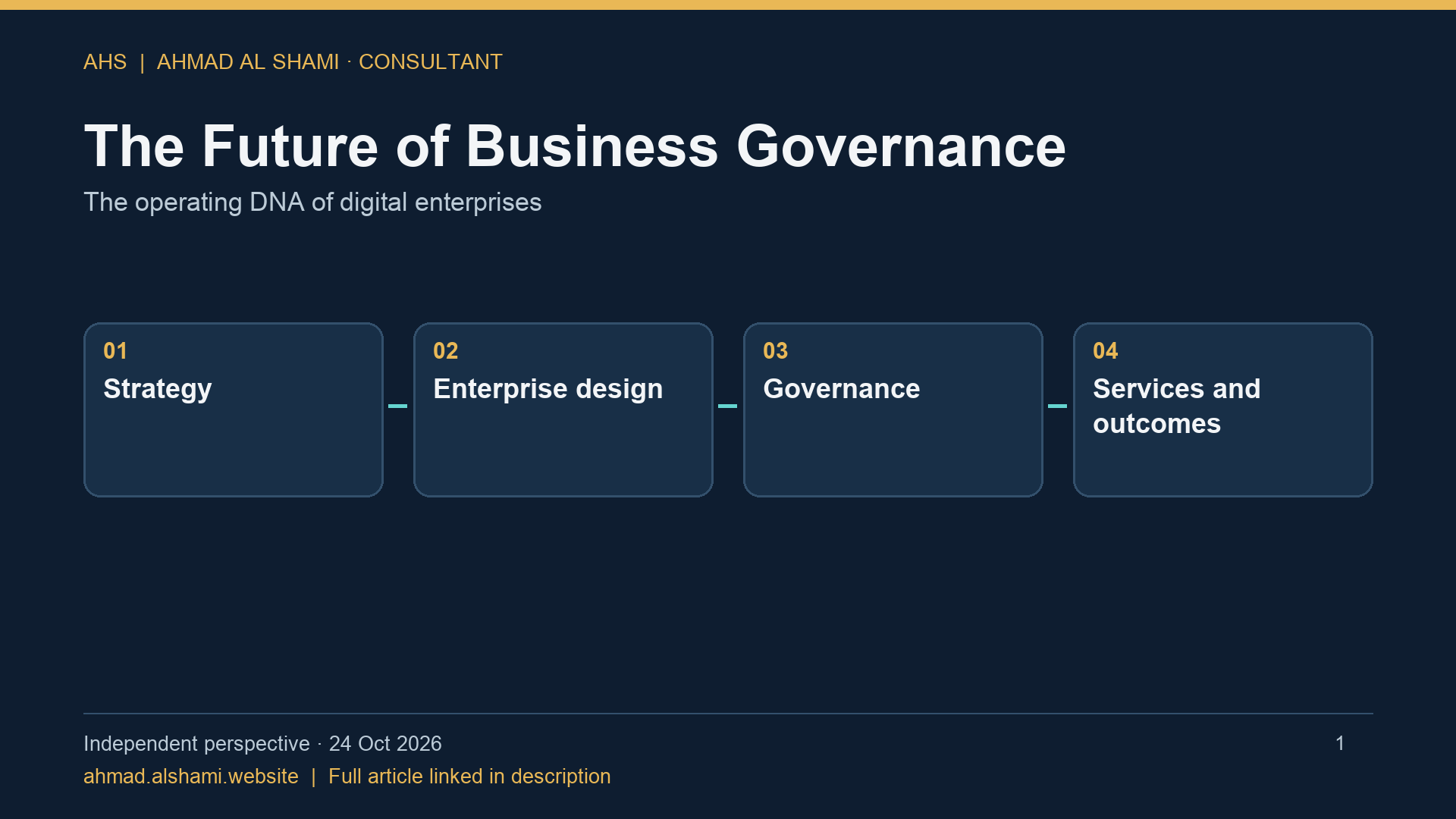
An executive perspective on the convergence of enterprise architecture, governance, service management, and autonomous business operations.
By Ahmad Alshami | October 2026
Introduction: The End of the Traditional Business–IT Divide?
For decades, organizations have treated information technology as a supporting function. Business leaders define strategy, establish policies, and manage operations, while IT departments provide the systems and infrastructure needed to support them.
I believe this relationship is undergoing a fundamental transformation.
As organizations evolve into digital and AI-driven enterprises, technology is no longer simply supporting business operations. It is becoming inseparable from how organizations are designed, governed, operated, and continuously improved.
This perspective is increasingly supported by leading research institutions.
In its December 2025 research briefing, Enterprise IT Operating Models in the AI Era, MIT CISR examined organizational operating models using 39 interviews across 30 companies and survey data from 152 enterprises. Researchers Alan Thorogood and Stephanie Woerner identified how AI is reshaping the relationship between business and IT, with strong technology leadership, modularity, and reuse playing important roles in enterprise innovation. [1]
Gartner's June 2026 research article, From IT Control to Technology Operating Model Orchestration, reported that 71% of CEOs considered their IT operating models unsuitable for the AI era. Gartner argues that organizations must move toward technology operating models characterized by shared ownership among IT, business leadership, and AI-enabled participants. [2]
These findings lead me to an important hypothesis:
Frameworks traditionally associated with IT and enterprise architecture—particularly TOGAF, COBIT, and ITIL—could become foundational management disciplines for the digital enterprise.
Not because IT will dominate business, but because business itself is becoming increasingly digital.
1. TOGAF: From Enterprise Architecture to Enterprise Design
TOGAF provides a structured approach to enterprise architecture, connecting strategic objectives with business capabilities, organizational structures, processes, applications, information, and technology.
The TOGAF Standard, 10th Edition, published by The Open Group, explicitly addresses evolving business strategy needs and digital transformation. [3]
I believe enterprise architecture will increasingly move beyond documentation and planning toward becoming a living representation of the organization.
Imagine an enterprise where strategies, policies, processes, organizational roles, systems, and KPIs are digitally interconnected.
A change in strategy could be assessed against impacted capabilities, operational procedures, technology dependencies, business risks, and expected outcomes.
This direction is consistent with Gartner's March 2025 public research abstract, Make the Shift to an Adaptive EA Governance Model, which argues for more adaptive enterprise architecture governance as digital delivery becomes increasingly decentralized. [4]
My prediction: Enterprise architecture will evolve from describing how an organization should operate toward providing an active architectural foundation for how it actually operates.
2. COBIT: From Technology Governance to Integrated Business Governance
COBIT provides principles and practices for the governance and management of enterprise information and technology.
Importantly, ISACA explicitly defines COBIT's scope as enterprise-wide, not limited to the IT department. [5]
This distinction becomes critical as organizations introduce autonomous AI agents, digital workflows, intelligent decision systems, and integrated business platforms.
Consider the questions that emerge:
Who authorizes an AI agent to approve a financial transaction? How are automated decisions controlled? Who remains accountable when an AI-driven process produces an unexpected outcome? How do organizations verify compliance continuously rather than relying only on periodic audits?
These are not simply IT questions. They are business governance questions.
The publicly available abstract of Gartner's May 2026 research on accountable teams in the age of AI emphasizes that sustained adaptability depends on well-governed autonomy rather than simply increasing centralized control. [6]
I believe COBIT's governance principles will increasingly contribute to the corporate governance mechanisms required to manage digital enterprises.
My prediction: Digital governance will become an inseparable component of business governance, with accountability shared between business leaders, technology leaders, risk functions, and governing bodies.
3. ITIL: From IT Service Management to Enterprise Service Management
ITIL has historically been associated with IT service management, but its principles extend to value creation, service delivery, service quality, change enablement, and continual improvement.
PeopleCert describes ITIL as a framework for digital product and service management, connecting strategy, delivery, and continual improvement. [7]
In a digital enterprise, almost every organizational function can be structured around measurable services.
For example, a real estate organization may offer tenant onboarding, leasing approvals, maintenance requests, procurement, financial reporting, and employee services.
Each service can have defined ownership, service levels, business outcomes, operating procedures, and performance measures.
Agentic AI can then help execute authorized activities, coordinate workflows across systems, and escalate exceptions.
This represents an opportunity to apply service management principles across the enterprise rather than restricting them to IT operations.
My prediction: Enterprise service management will become an important operational discipline as organizations increasingly deliver their capabilities through interconnected digital services.
4. Agentic AI: Connecting Architecture, Governance, and Execution
The emergence of Agentic AI introduces an additional dimension to this transformation.
Traditional enterprise operating models document how an organization should function. AI-enabled digital operating models create opportunities to automate and coordinate parts of that functioning.
The publicly available abstract of Gartner's April 2026 research, How AI Changes the IT Operating Model, identifies AI as a catalyst for organizational reinvention, requiring changes in shared leadership, organizational skills, and ways of working. [8]
This creates an opportunity to connect complementary management disciplines:
- TOGAF helps architect enterprise capabilities and their relationships.
- COBIT supports governance, accountability, risk management, and control.
- ITIL provides service management and continual improvement practices.
- Agentic AI enables increasingly intelligent orchestration and execution.
- Business performance intelligence measures outcomes and identifies deviations between intended and actual organizational behavior.
Consider a practical example.
A business policy establishes financial approval limits. Enterprise architecture connects that policy to organizational roles, business processes, and supporting applications. Governance defines authorization and accountability. Service management establishes performance expectations. An AI agent executes an eligible transaction within approved limits or escalates an exception. Monitoring and assurance mechanisms verify compliance and measure results.
The organization moves toward an operating environment where strategy, policy, architecture, execution, and performance become continuously connected.
However, technology does not automatically make this model reliable. Machine-readable policies, trustworthy data, authorization controls, security, auditability, and human oversight must be deliberately engineered.
5. From Digital Transformation to Governed Autonomous Enterprises
The long-term opportunity extends beyond automating individual business processes.
I envision the emergence of the Governed Autonomous Enterprise, in which operating activities are increasingly coordinated through digital platforms and intelligent agents within explicitly defined business controls.
This does not mean eliminating leadership, judgment, or accountability.
Instead, human leaders determine objectives, priorities, ethical boundaries, and acceptable risk. Digital systems and authorized AI agents increasingly coordinate routine execution, while performance intelligence supports ongoing monitoring and improvement.
MIT CISR's research provides an important foundation for this vision. Its 2025 enterprise IT operating model study informs this discussion of how organizations need to balance innovation speed with strong enterprise technology leadership, reusable capabilities, and effective governance. [1]
Similarly, Gartner's 2026 research advocates moving away from rigid technology control toward orchestration across business functions, shared digital assets, and AI-enabled operations. [2]
Together, these findings support an important conclusion: future operating models will increasingly depend on enterprise-wide integration of architecture, governance, technology, and organizational execution.
My proposed extension is that TOGAF, COBIT, and ITIL can provide complementary disciplines for designing and managing this integrated environment.
6. The Next Evolution: From IT Frameworks to Enterprise Management Disciplines
Historically, organizations have treated enterprise architecture, IT governance, and service management as specialist domains.
I believe this categorization will become less relevant.
As business operations become more digital, the underlying disciplines of these frameworks can increasingly influence corporate management.
TOGAF can help connect strategic direction with enterprise design.
COBIT can help translate governance expectations into digital decision rights, accountability, and controls.
ITIL can help manage the reliability and continual improvement of enterprise digital services.
Agentic AI can enable authorized actions and coordinated execution across those capabilities.
Importantly, these frameworks do not independently constitute a complete business operating model. Corporate governance, financial management, human capital, organizational culture, industry regulations, and strategic leadership remain indispensable.
The opportunity is to integrate these disciplines rather than replace business management with technology management.
Conclusion: Technology Will Not Dominate Business — Its Disciplines Will Become Part of Business DNA
I believe the next stage of enterprise transformation is not merely about digitizing processes or introducing artificial intelligence.
It is about fundamentally redesigning how organizations operate.
The traditional separation between business management and IT management will increasingly give way to more integrated approaches in which strategy, architecture, governance, digital services, and intelligent execution form a coherent operating model.
MIT CISR and Gartner research supports the direction of business–technology convergence; it does not validate this proposed combination of frameworks.
My hypothesis takes the argument one step further:
TOGAF, COBIT, and ITIL could evolve from frameworks traditionally associated with technology into foundational disciplines of enterprise management, with Agentic AI serving as an increasingly important execution capability.
The future organization may be judged not only by its strategy or the technologies it adopts, but by how effectively it connects strategic intent, architectural design, governance, execution, and measurable business outcomes.
The question for executives is therefore no longer simply:
How can technology better support our business?
It is:
How do we architect, govern, and operate an enterprise that is digital by design, intelligent by execution, and accountable by governance?
That, I believe, is where the future of business is heading.
References
[1] MIT Sloan – Center for Information Systems Research (MIT CISR). Thorogood, A., & Woerner, S. L. (2025, December 18). Enterprise IT Operating Models in the AI Era. Research Briefing XXV-12. https://cisr.mit.edu/publication/2025_1201_EntITOperatingModels_ThorogoodWoerner
[2] Gartner. Watt, S. (2026, June 15). From IT Control to Technology Operating Model Orchestration. https://www.gartner.com/en/articles/it-operating-model
[3] The Open Group. (2022, April 25). The Open Group Announces Launch of the TOGAF Standard, 10th Edition. https://www.opengroup.org/open-group-announces-launch-togaf-standard-10th-edition
[4] Gartner. Allega, P., Jhawar, A., & Kaur, M. (2025, March 28). Make the Shift to an Adaptive EA Governance Model. https://www.gartner.com/en/documents/6313147
[5] ISACA. COBIT 2019 Framework: Governance and Management Objectives. https://www.isaca.org/store2/product/CB19FGMP-C
[6] Gartner. Gulzar, R., Heyes, J., et al. (2026, May 25). Tech Operating Model Change Imperative: Enable Autonomy and Agility Through Accountable Teams in the Age of AI. https://www.gartner.com/en/documents/7901477
[7] PeopleCert. ITIL: Global Best Practice for Digital Product and Service Management. https://www.peoplecert.org/ITIL-4
[8] Gartner. Gibson, M. (2026, April 28). How AI Changes the IT Operating Model. https://www.gartner.com/en/documents/7775753
Research note: This article combines documented research findings with the author's independent forward-looking interpretation. The proposed convergence of TOGAF, COBIT, ITIL, and Agentic AI is a conceptual thesis, not a formally endorsed MIT or Gartner framework. Gartner document citations use their public abstracts; full subscription reports were not reviewed. The public Gartner article does not disclose the methodology behind its 71% figure.
Watch the business perspective
American Michael narration · Original business illustrations · Updated to reflect the original article.